

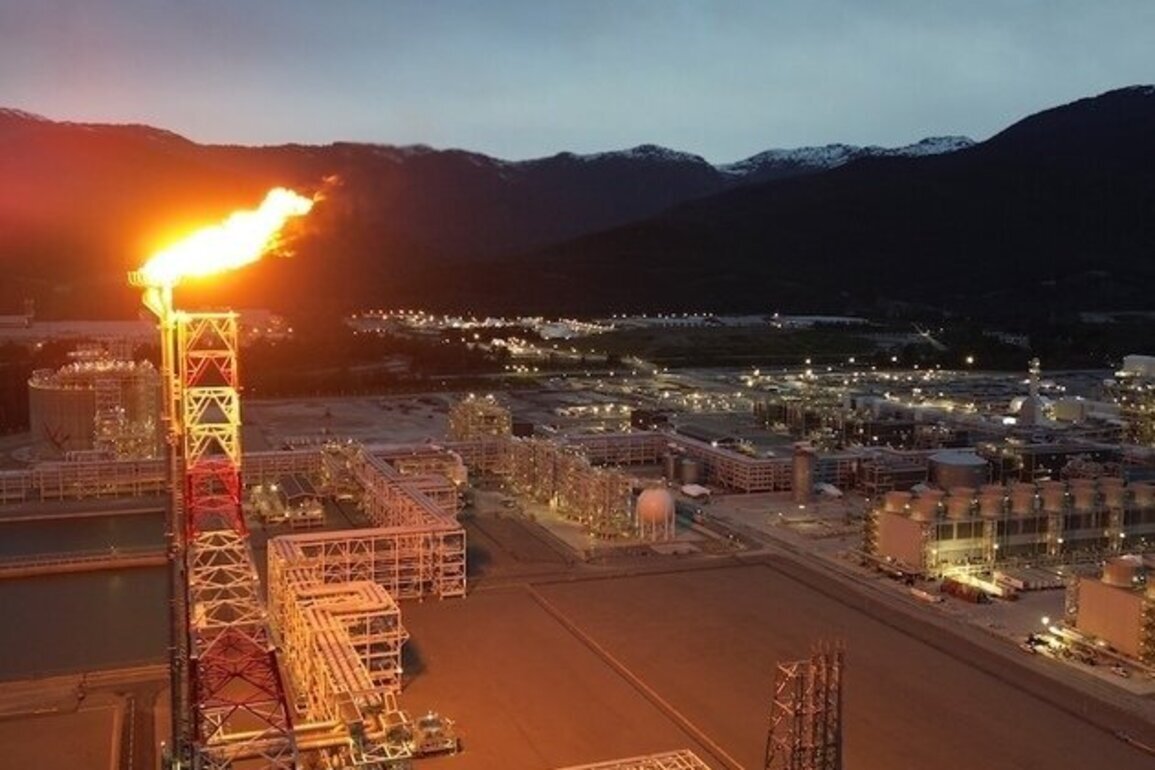
As LNG Canada's export terminal in Kitimat edges toward a major expansion amid mounting opposition, a veteran Texas air quality expert told The Energy Mix that the British Columbia regulator is giving the facility what he calls a "free pass" on emissions.
Tim Doty, an air quality expert with Texas group Oilfield Witness who worked for more than 30 years as a technical air expert at the Texas Commission on Environmental Quality, spent three days in May observing venting and flaring at the Kitimat site. "I've surveyed many hundreds of industrial flares across the state of Texas and Louisiana, and this one is not typical," Doty said.
His assessment comes as documents obtained under multiple freedom of information requests reveal labelling errors, excessive flaring, black smoke, broken equipment, and a suspended gas purification system at the facility. Health professionals and locals are alarmed. Civil society groups are outraged.
"Canadians, especially those in LNG host communities, deserve to know at what point the continued exposure of communities to unabated flaring triggers a proportionate and urgent policy response," writes an unusually broad coalition of signatories in a recent letter to Prime Minister Mark Carney, B.C. Premier David Eby, and relevant ministers at both the federal and provincial level.
The letter followed reports that the Kitimat facility regularly exceeded its monthly authorized emissions by an average of 40 times, exposing local residents to excess flaring. Signed by the Canadian Association of Physicians for the Environment (CAPE), the Canadian Association of Nurses for the Environment, Environmental Defence, Shift: Action for Pension Wealth and Planet Health, and dozens of other organizations, the letter urged federal and provincial authorities to mandate an "industry-funded independent, cumulative health impact assessment for British Columbia's gas and LNG industry."
Such an assessment could then be used to inform communities across Canada about potential public health risks, both those that have already signed on to Canada's burgeoning LNG industry, and those that are contemplating the option.
The intense flaring activity at the Kitimat site is but the very end of a "harm chain" that originates in the massive gas fields of the Montney Formation and communities like Dawson Creek, where a "piecemeal" permitting process poses great risks to public health, Tim Takaro, a Simon Fraser University professor emeritus trained in occupational and environmental medicine, told The Mix in an interview. "There are harms all along the way, and we need to look at the whole enchilada, because that's how health impacts must be assessed."
LNG Canada's export facility in Kitimat began shipping natural gas to Asian markets in June 2025. Nearly a year later, the plant is in regular operations, but closely mirrors startup condition, a status which involves much unplanned and poorly regulated flaring as engineers fine-tune a complex and dangerous system of pressurized piping into steady-state conditions.
While often presented as a short-term process, startup flaring can last for as long as two years.
Flaring has been particularly intense at the Kitimat facility, putting it among the highest-flaring LNG facilities in the world, according to an investigative report by The Narwhal based on data from satellite imagery.
As LNG Canada's own air waste permit confirms, flaring contains a number of known toxins, including fine particulate matter (PM 2.5) and black carbon-both serious threats to heart and lung health-plus nitrogen dioxide, a primary trigger for asthma, and benzene, a carcinogen so potent there are no "safe" levels of exposure.
Even as it remains in startup condition, the facility is ramping up production.
The company began "sharply boosting" exports in March, with the expectation that export volumes in the first three months of the year would "easily surpass" those of its first six months of operation the Globe and Mail reported mid-month.
And those expectations are being realized. In the first eight months of operation, LNG Canada exported an estimated 4.6 million tonnes of liquefied natural gas to Asia. In April alone, it exported one million tonnes, reports Reuters.
By its own accounting, the company has been a model corporate citizen throughout the ramping up process.
"LNG Canada continues to safely and responsibly advance its early operations," LNG Canada spokesperson Paul Hagel said in a mid-March statement.
LNG Canada's stature as a "responsible" producer of energy was repeatedly referenced during a May 14 press conference in Vancouver announcing progress toward a Final Investment Decision (FID) on the company's proposed Phase 2 expansion, which is among the projects referred to Carney's new Major Projects Office (MPO).
Canada is now "one step closer" to becoming a "leading exporter of clean, responsibly produced energy," Intergovernmental Affairs Dominic LeBlanc said in a release.
"Now is the moment for purposeful collaboration to satisfy all the requirements necessary for a positive FID and seize a generational opportunity that could materially increase the scale of reliable, responsibly produced, made-in-B.C. LNG for decades to come," said LNG Canada CEO Chris Cooper.
That view isn't shared by scientists, experts, or advocates. Explaining that "LNG is mostly methane, it is a fossil gas, and cannot logically be a climate solution," Ecojustice lawyers, on behalf of citizens group My Sea to Sky, advised Carney, federal ministers, and the MPO in a legal letter May 4 that it would file a constitutional challenge if any public financing or subsidies are provided to the Kitimat expansion. Ecojustice counted the LNG facility among fossil fuel projects like oil pipelines that would deliver climate harms and "aggravate the affordability crisis that Canadians are enduring."
"Public financing that enables new fossil fuel infrastructure worsens both the climate crisis and the risks to Canadians' Charter-protected rights," states the letter. "Any claim that these fossil fuel projects are 'clean' or climate positive is wrong."
"These LNG export projects will cause significant GHG emissions, accelerating the climate crisis and the negative impacts on the lives and health of Canadians."
Sudden disabling cracks in a flare stack, and a critical air quality protection system offline for a month, are latest revelations in an ongoing saga of major operational failures at the facility.
An LNG Canada document obtained by University of Victoria air quality researcher Laura Minet under a freedom of information request shows a crack developed on the flare tip of the facility's warm/wet flare stack on February 18, followed by another on February 23.
The document, a mandated report detailing LNG Canada's March emissions, further shows that one of the facility's two acid gas incinerators (AGI) was offline due to an "extended maintenance outage" the entire month of March, while the other was down from March 14 to March 18.
AGIs play an indirect, but critical, role in protecting public health as they remove highly toxic chemicals like hydrogen sulphide and benzene, as well as carbon dioxide, from raw natural gas, before it is chilled and liquefied preparatory to shipping.
The cracks in the flare tip led to the shutdown of the entire stack. The gas it would have burned was rerouted to a "spare" stack for flaring.
In correspondence with The Mix, the BCER confirmed a detail absent from the March report-at least from its executive summary: namely, that gas that would normally have been routed through the AGI was also redirected into the spare flare stack, a move which "achieves similarly satisfactory combustion of the gases," according to the regulator.
The upshot of all this redirection was that the spare stack released far more gas- a total of 16.7 million cubic metres over the thirty-one days- than either the functioning cold/dry flare stack (6.79 million cubic metres) or a storage and loading stack (1.1 million cubic metres).
All of these flare volumes were released when the stacks were in "non-routine" status, which covers maintenance, process upset, and emergency scenarios. In these cases, the authorized rate of flaring is "as required"-meaning without specified limits, according to [pdf] the permit that BCER issued to LNG Canada.
The spare stack was considered to be in "non-routine" status throughout the month of March, thanks mostly to the offline AGI, the BCER told The Mix. The other two stacks had periods of routine flaring, with tallies for the month far exceeding permitted limits.
"The regulator should be holding LNG Canada accountable to its permits, and if LNG Canada is not able to meet those permits then it should issue a stop-work order until it fixes the problem with the flare tip and can operate within the conditions of its permit," My Sea to Sky Executive Director Tracey Saxby, who travelled to Kitimat with the Texas expert Doty, told The Canadian Press. My Sea to Sky is based in Squamish, site of the Woodfibre LNG project, now under construction.
A replacement tip for the cracked flare is onsite, and the replacement process will begin June 15, LNG Canada said in its March report.
"Replacement of the facility flare tip is a complex operation that requires detailed work planning and the support of specialist contractors to complete the work safely," BCER told The Mix, explaining why replacement could not begin immediately.
"The BCER is regularly engaging with LNG Canada on the replacement of the flare tip and will continue to closely monitor execution of the work," the regulator added.
Responding to The Mix's query about data quality in LNG Canada's March emissions report-because the company used two different types of cubic metre measurements to describe flare gas volumes-BCER wrote that a labelling mistake had occurred.
"The BCER has confirmed this with LNG Canada and has reminded the company to ensure units are labelled consistently moving forward," the regulator added.
Tim Doty takes a dim view of LNG Canada's operational procedures at its Kitimat facility and how it's kept in check. The persistent non-routine status suggests to him inexperience on the part of plant operators, or that the facility wasn't designed properly in the first place, he told The Mix.
On LNG Canada's license to flare "as required" whenever the stacks enter non-routine status, he said: "That wouldn't be what we do in Texas."
It amounts to a "free pass" from the regulator, said Doty, who successfully testified before the Texas Legislature against a bill that would have fined residents for repeated complaints to the TCEQ. Texas, known as the 'energy capital of the world,' is itself a permissive state, Doty explained. "The TCEQ is in business to permit industry," he said. "That's their number one function."
Doty retired from the TCEQ in 2018, disenchanted by a deficient monitoring regime. But at least on paper, the state still takes a harder line on flaring than B.C. appears to, he said.
Echoing Saxby, Doty added that a stop-work order should be issued until LNG Canada gets its house in order.
Both LNG Canada and the regulator point to stationary air monitors around Kitimat that consistently show average ambient air pollution levels well below mandated guidelines as evidence that public health concerns about exposure to toxins like PM 2.5, nitrogen dioxide, and VOCs like benzene are overstated.
But there are multiple problems with this default position, SFU's Takaro told The Mix.
"First of all we know that exposure across the whole airshed is not uniform: there will be pockets of concentrated pollutants" that averages cannot capture, a regulatory gap that puts public health at risk, he explained.
"A very short-term exposure to nitrogen dioxide, for example, can trigger an asthma attack," Takaro said.
The absence of strict caps on exposure to nitrogen dioxide, or even benzene, is another problem. Compounding this regulatory failure: the guidelines that are in place "are generally based on the 70-kilogram white male."
"So, not protecting young children, certainly not babies in utero, and probably not older people with chronic obstructive pulmonary disease, which is the most prevalent pulmonary condition in Canada," Takaro said.
"There is so much wanting in the regulatory structure, and even with all of that, this facility is going way past the guidelines."
Another problem: the BCER has no in-house expertise informing its approach to public health concerns. The number of public health staff working for the regulator is "precisely zero," Takaro told The Mix.
And then there is the BCER's tendency to slow-walk any disciplinary action. The regulator gave LNG Canada six months to remedy an ongoing release of toxic black smoke-a release the company had failed to immediately disclose to the regulator.
The BCER is "absolutely toothless," Takaro said.
Like Doty and Saxby, he believes a stop-work order has become necessary.
"I am not going to hold my breath for it, though," he said.
Source: The Energy Mix